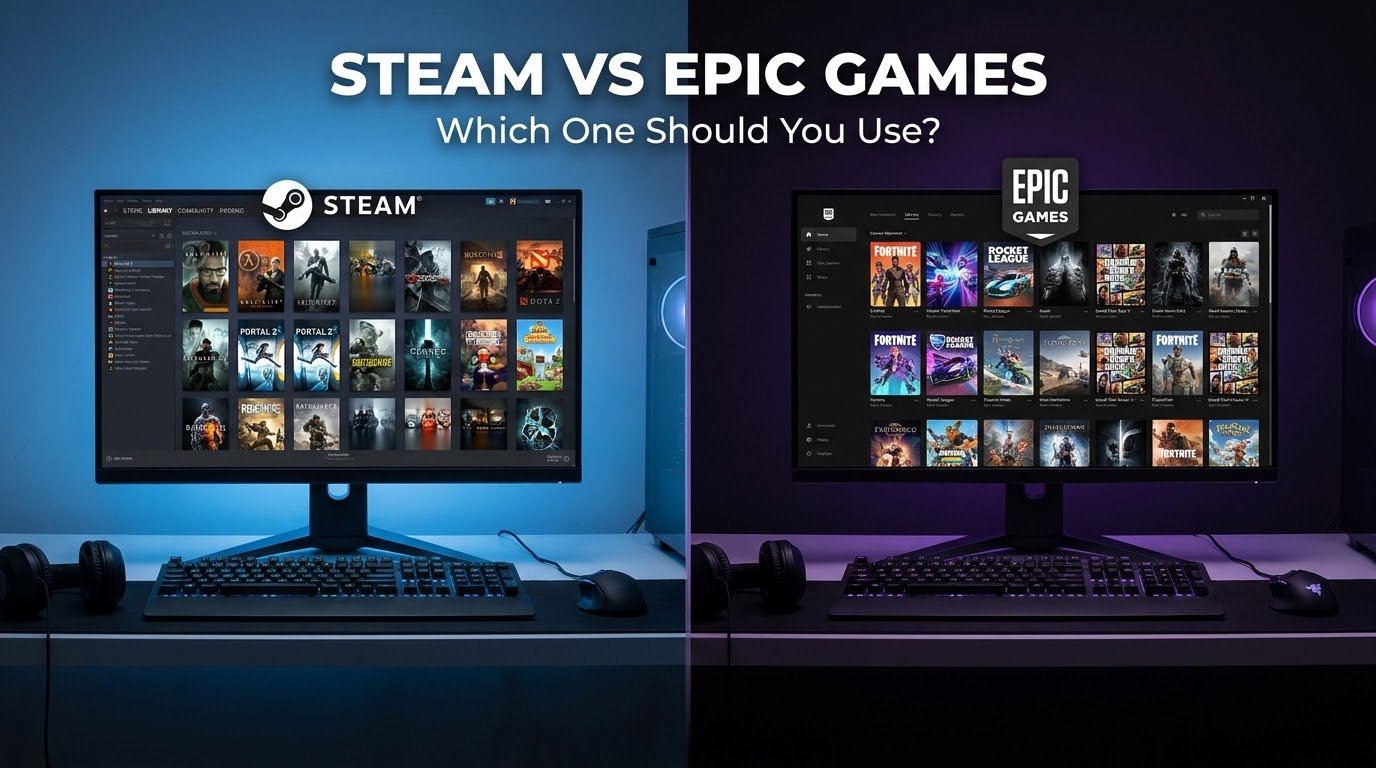
A few years back, a friend refused to install Epic Games Store on principle. Wouldn’t touch it. Said he was “a Steam guy” like it was a personality trait. Then Epic gave away Control and GTA V for free in the same year, and I watched him quietly download the launcher he swore he’d never use, claim both games, and never bring up his boycott again.
That pretty much sums up the whole Steam vs Epic debate. People have strong opinions about these platforms, but most of those opinions soften the moment free games or a better deal show up.
I’ve used both for years now, own games on each, and genuinely have no loyalty to either one beyond wanting the best deal and the smoothest experience. So here’s the honest, no-fanboy breakdown of where each one actually wins.
The quick version, if you’re in a hurry
Steam is the better all-around platform. Bigger library, better community features, mod support, family sharing, Steam Deck integration, and a refund policy that’s actually reasonable. If you could only pick one launcher for the rest of your gaming life, Steam is the safer, more complete choice.
Epic is worth keeping installed anyway, mainly for the weekly free games. That’s not a small perk either, Epic has given away hundreds of games since 2018, including legitimate AAA titles, and if you just log in once a week to claim whatever’s free, you build a surprisingly solid library at zero cost over time.
That’s the short answer. Here’s the actual reasoning, and the stuff that surprised me along the way.
Library size and what you can actually buy
Steam’s library is enormous, well over 100,000 titles at this point, covering everything from massive AAA releases to tiny experimental indie games nobody’s ever heard of. If a PC game exists, there’s a very good chance it’s on Steam.
Epic’s library is much smaller by comparison. It leans toward curated, higher-profile releases rather than trying to host everything. That’s not necessarily bad, it just means if you’re hunting for something obscure or niche, Steam is far more likely to have it.
The free games situation (this is where Epic actually shines)
This is genuinely Epic’s strongest card, and it’s not close. Every Thursday, Epic gives away one or more games that you keep permanently once claimed, no subscription required. I’ve personally claimed games this way that I would’ve otherwise paid full price for, including some legitimate AAA titles in the rotation.
Steam has something similar called Free-to-Keep, but it’s a different animal entirely. It’s publisher-driven rather than something Steam runs consistently, and honestly, the quality is a mixed bag. You’ll occasionally get something decent, but a lot of the Free-to-Keep titles are smaller releases that didn’t get much attention when they launched. Steam is also home to genuinely great permanently free-to-play games like Team Fortress 2 and Dota 2, but those are funded through in-game purchases, not a weekly giveaway.
My honest take: if you only check one platform for free games, make it Epic. Set a weekly reminder if you have to. It genuinely adds up over a year.

Pricing and sales
Steam runs deep, frequent sales throughout the year, and most PC gamers already know the rhythm of waiting for a Steam Sale before buying something at full price. That culture is basically built into how people shop on Steam at this point.
Epic runs sales too, and its Epic Rewards program gives a percentage back as store credit on purchases, which occasionally gets boosted during promotional periods. It’s a decent perk, but it hasn’t fully replicated the sale culture Steam built over two decades.
Behind the scenes, there’s also a difference in how much of your money actually goes to the developer. Epic takes a flat 12% cut, while Steam’s cut is tiered, starting around 30% and dropping as a game sells more copies. This mostly matters if you care about supporting developers directly, but it’s part of why some smaller studios prefer launching on Epic first.
Features that actually matter day to day
This is where Steam pulls ahead by a wide margin, and it’s not particularly close.
Steam has:
- Cloud saves across devices
- Family sharing, so you can share your library with people in your household
- A massive, active community with reviews, guides, and forums for almost every game
- Steam Workshop for mods, which is genuinely one of the best mod-browsing systems out there
- Native Steam Deck and Linux support
- A well-established, player-friendly refund policy
Epic has:
- A cleaner, more minimal interface
- Cross-platform play support for many titles
- Occasional exclusive or timed-exclusive releases
- A shopping cart feature, which took them a surprisingly long time to add
If you’re someone who mods your games, plays on Steam Deck, or shares your library with roommates or family, Steam is functionally a different tier of platform. Epic still feels like it’s catching up on the basics that Steam nailed down years ago.
Step-by-step: how I’d actually set this up if you’re starting fresh
- Install Steam first. It should be your primary, default platform for most purchases given the library size and features.
- Install Epic Games Store separately, but only really open it once a week. Set a recurring reminder for Thursday, when new free games usually drop, so you’re not missing out on the giveaway.
- Check both platforms before buying anything new. Prices, regional discounts, and promotional periods vary between the two, so a quick price comparison takes thirty seconds and can save you real money.
- If you’re on Steam Deck or Linux, lean almost entirely on Steam. Epic has no native Linux client, and running Epic titles on Deck requires switching to Desktop Mode and setting up something like the Heroic Games Launcher, which is more setup than most casual players want to deal with.
- Consider a unified launcher if you’re managing a lot of platforms. Tools like Playnite let you view your Steam, Epic, GOG, and other libraries in one place, which helps if your collection is scattered across multiple storefronts.
A mistake I made early on
For a while, I avoided claiming Epic’s free games because I assumed there’d be some catch, hidden fees, some kind of subscription trap. There isn’t one. Creating an account and claiming weekly games costs nothing, no strings attached, you just need the launcher installed and a few seconds each week.
I probably missed out on ten or more free games over about a year just from that unfounded assumption. Lesson learned: the free games are exactly what they sound like.
Common mistakes people make
Assuming Steam and Epic libraries automatically sync or transfer. They don’t. Games bought on one platform stay on that platform, there’s no cross-transfer system between them.
Forgetting to claim Epic’s weekly free games. If you don’t log in and manually claim it before the week ends, you miss it, it doesn’t stay in your account automatically.
Buying a game full price on release day without checking both platforms. Prices and regional discounts can genuinely differ, so a quick check across both before buying saves money more often than you’d expect.
Ignoring Epic entirely out of brand loyalty. I get the instinct, but you’re leaving free, legitimately good games on the table for no real reason.
Assuming Epic titles work fine on Steam Deck without extra setup. They don’t run natively, and skipping that reality leads to frustration if you’re not prepared for the extra configuration involved.
Final thoughts
Neither platform needs to win outright, and pretending you have to pick a side is honestly a waste of energy. Steam is the stronger, more complete platform for almost everything that matters day to day, mods, community, Deck support, family sharing. Epic earns its spot anyway, purely through consistent, genuinely valuable free games that cost you nothing but a few seconds a week to claim.
My friend who swore off Epic on principle now has both launchers installed, and I’d bet good money you’ll end up in the same spot if you haven’t already. There’s no real downside to running both, only to ignoring one of them out of stubbornness.