The RTX 5090 launched at a $1,999 MSRP. In a Tom’s Hardware report dated August 7, 2026, the best price it cited for a working RTX 5090 was $4,381.
A quick note on terms, because they get mixed up. MSRP is the launch price Nvidia suggested. The “lowest tracked price” is the cheapest listing a tracker found, which is not the same as what most people paid, and it says nothing about whether one card is sitting in a warehouse at that price. The Tom’s Hardware piece doesn’t say which retailers or region its figures cover, or the exact day they were checked.
You could wave off the 5090 as a halo card for people with more money than sense. I’d have done the same until I looked at the cards normal people buy. The same report lists the RTX 5070 Ti at $989 against a $749 MSRP. A separate MLQ roundup of US retailer checks from July 30 to August 3, 2026 put the 16GB RTX 5060 Ti at roughly $570 against a $429 launch price. That roundup is a secondary source that combines Tom’s Hardware and PC Gamer trackers, so treat that one number a little more carefully than the others.
It’s not one weird product, and it’s not the old routine where a new generation shows up and last year’s cards get cheap. I wanted to know where that routine broke.
Here is how to read what follows. Figures with a source are reported facts. Anything labeled an estimate or a report is exactly that. “My read” marks my own interpretation, which you can disagree with.
What the shelves looked like in early August
These are the lowest prices cited in the August 7 Tom’s Hardware report, set against launch MSRPs.
| Card | Launch MSRP | Lowest price cited | Difference vs MSRP |
|---|---|---|---|
| RTX 5090 | $1,999 | $4,381 | up 119% |
| RTX 5080 | $999 | $1,289 | up 29% |
| RTX 5070 Ti | $749 | $989 | up 32% |
| RTX 5070 | $549 | $629 | up about 15% |
These are snapshots. Prices move every week, and they vary by retailer, region and stock. Tom’s Hardware also notes that RTX 50 cards took several months to dip below MSRP and that the dip lasted only a few months once the memory shortage took hold. So these cards didn’t start expensive and stay there. They went up.
Stop one: the memory squeeze
The lazy version of this story says AI and gamers are fighting over the same chips. The evidence points somewhere more specific.
Epoch AI estimated in March 2026 that the four largest AI chip designers (Nvidia, Google, AMD and Amazon) consumed over 90% of global CoWoS packaging capacity and HBM supply in 2025, measured by value for HBM. They used only about 12% of advanced logic die production (3 to 5nm wafers). These are modeled estimates from a Monte Carlo simulation, not audited figures, and Epoch notes its numbers for Google and Amazon are probably understated.

Those are different resources, and it matters. HBM is the stacked memory used on data center accelerators. CoWoS is a packaging step. GDDR7 is the memory on gaming cards. Logic dies are the processors themselves. A shortage in one doesn’t automatically mean a shortage in the others. The link to gaming cards is indirect: the same memory makers have limited capacity to split between products.
The makers say demand is strong. SK hynix’s head of DRAM marketing, Kim Kyu-hyun, said the company had “sold out our DRAM, NAND, and HBM capacity for next year,” as reported by Notebookcheck after its Q3 2025 results. On Micron’s September 2025 earnings call, CEO Sanjay Mehrotra said the company expected to conclude agreements to sell out the rest of its calendar 2026 HBM supply, and already had pricing agreements with almost all customers for a vast majority of its HBM3E supply in 2026, per a call transcript.
On price, TrendForce reported in December 2025, citing a Chosun Biz report based on unnamed sources, that Samsung and SK hynix raised HBM3E supply prices by nearly 20% for 2026. Neither company confirmed it.
You’ll also see a claim that data centers will take 70% of the world’s memory in 2026. SoftwareSeni attributes it to Clarifai, as “up to 70% of global memory supply.” A January 2026 HWBusters article words it as over 70% of “high-end DRAM production,” with no source named. I couldn’t trace either to Clarifai’s original work or find out which memory types it covers, so I’m treating it as an unverified forecast.
Tom’s Hardware’s August 7 report mentions GDDR7 modules pushing past $20 and TSMC wafer costs rising, in the course of discussing South Korea. That’s one outlet’s reporting, not a market-wide price list.
My read: this looks more like a memory squeeze than a chip squeeze. Less catchy than “AI ate the GPUs,” but closer to what the sources show.
Stop two: does Nvidia ration memory by revenue per gigabyte?
This is the part that caught my attention, and also the part I’m least able to prove.
Gigabyte CEO Eddie Lin told Tom’s Hardware at CES 2026 that Nvidia would prioritize some product segments over others, saying “They will calculate how much revenue [each segment] contributes per gigabyte of memory.” I couldn’t open the original Tom’s Hardware interview, so I’m relying on Wccftech’s summary of it and Tom’s Guide’s write-up. Lin is a board partner CEO describing how he believes Nvidia thinks, and his own examples were hypothetical ($35, $50 and $32 per gigabyte). I found no public Nvidia statement saying this.
A chart in that coverage, credited to Tom’s Hardware, lists “revenue per GB” for several cards. The sources don’t explain how it was calculated, but the numbers match launch price divided by memory capacity: about $8,500 over 96GB gives $88.54 for the RTX Pro 6000, $1,999 over 32GB gives $62.47 for the RTX 5090, and $429 over 16GB gives $26.81 for the 16GB RTX 5060 Ti. So this is a launch price per gigabyte of VRAM, not Nvidia’s actual revenue or margin per gigabyte. It’s a useful rough proxy for what a gigabyte “earns” inside different products. It doesn’t tell us what Nvidia truly makes. The $8,500 RTX Pro 6000 price comes from SoftwareSeni, and other outlets reported slightly different launch prices.
By that rough proxy, a gigabyte inside the pro card is worth about 3.3 times a gigabyte inside the 16GB gaming card. If Nvidia does allocate by something like that, mid-range 16GB cards would be the ones to lose out. That’s a hypothesis, and nobody has published production allocation numbers that would confirm it. It also can’t explain retail prices alone. Memory costs, wafer costs, tariffs, demand and retailer pricing all play a part.
Nvidia told Tom’s Guide: “We continue to ship all GeForce SKUs and are working closely with our suppliers to maximize memory availability.”
There’s also a reported supply cut. Outlook Respawn wrote on December 19, 2025 that “Reports suggest NVIDIA might reduce the supply of its upcoming RTX 50 series by 30% to 40% due to GDDR7 shortages,” naming the 16GB RTX 5060 Ti and the RTX 5070 Ti as the supposed first in line. It doesn’t name an original source, Nvidia never confirmed it, and I found no evidence that the cut happened. Please don’t read it as fact.
What Nvidia’s earnings do and don’t show
For the quarter ended July 26, 2026, Nvidia reported $96.2 billion in revenue, $89.0 billion from Data Center and $7.2 billion from Edge Computing. Those two add up to the total, and Data Center is about 92.5% of it. Data Center revenue was up 117% from a year ago.
Since May, Nvidia reports only those two platforms. Its first-quarter CFO commentary describes Edge Computing as covering devices including PCs, game consoles and workstations, plus robotics and automotive. TweakTown reports that GeForce RTX hardware moved into that segment. The earnings release never breaks out gaming or GeForce revenue.
That’s all the evidence supports. We can’t tell what share of the $7.2 billion is gaming, so I’m not going to guess. And not having a gaming line doesn’t prove Nvidia stopped caring about gamers. It only means outsiders can’t see the number, which limits what anyone can claim in either direction.
Stop three: the board partners, where the evidence cuts both ways
Asus, Gigabyte, MSI and the other board partners build most of the cards you can buy. The evidence about their position is mixed and mostly old.
The clearest case is EVGA. When it stopped making Nvidia cards in September 2022, EVGA said it was losing hundreds of dollars on RTX 3080 and 3090 cards after Nvidia’s price cuts and that it found out final suggested prices at Nvidia’s public announcements, as covered by TechSpot. Those are EVGA’s own claims, as relayed by TechSpot. Jensen Huang’s response was that EVGA were “great partners” he was sad to see leave, and he said its CEO had wanted to wind down the business for years. That’s one company in 2022, not a description of 2026.
The margin data points the other way. A PCGamesN report citing DigiTimes said Taiwanese partners (Asus, Gigabyte, MSI and TUL) were “still keeping their gross margins at around 20%” despite large stock levels, up from 8 to 10% “at the start of last year.” The page shows no date, and it describes an earlier period, so it isn’t a 2026 figure. I couldn’t find a current margin figure for these companies and would be wary of anyone who says they have one.
Stop four: the shop
Retailers get blamed first because they’re the ones showing you the number.
When RTX 50 prices jumped in February 2025, Newegg replied to customers on X with “yeah, tariffs” and “Our GPUs are from China,” as PCMag reported. PCMag put the tariff-related increases at $100 to $400 depending on the model, and also noted that Newegg’s increases appeared to exceed the 10% tariff and that some buyers questioned whether vendors were leaning on tariff news and low supply. That’s one retailer’s reply in one month of 2025. It shows tariffs were part of that episode. It doesn’t show tariffs explain all GPU prices.
I looked for a reliable public figure for what retailers earn on a graphics card and couldn’t find one. When launches sell out in hours, a store can ask almost anything. Whether that shows up as fat margin or just survival, I can’t tell you. You can also read:
- What Happens to a Game You Bought When the Servers Shut Down
- My Camera Kept Drifting Right Mid-Fight, and It Cost Me the Match
Why old cards no longer drop in price
This is the one that bugs me most, because it used to work.
In August 2022, Tom’s Hardware reported EVGA discounting most of its 3090-tier cards by up to 42%, with an Asus RTX 3080 Ti TUF as low as $833 on Newegg Shuffle. It tied this to the 2022 crypto crash, with partners looking to dump inventory.
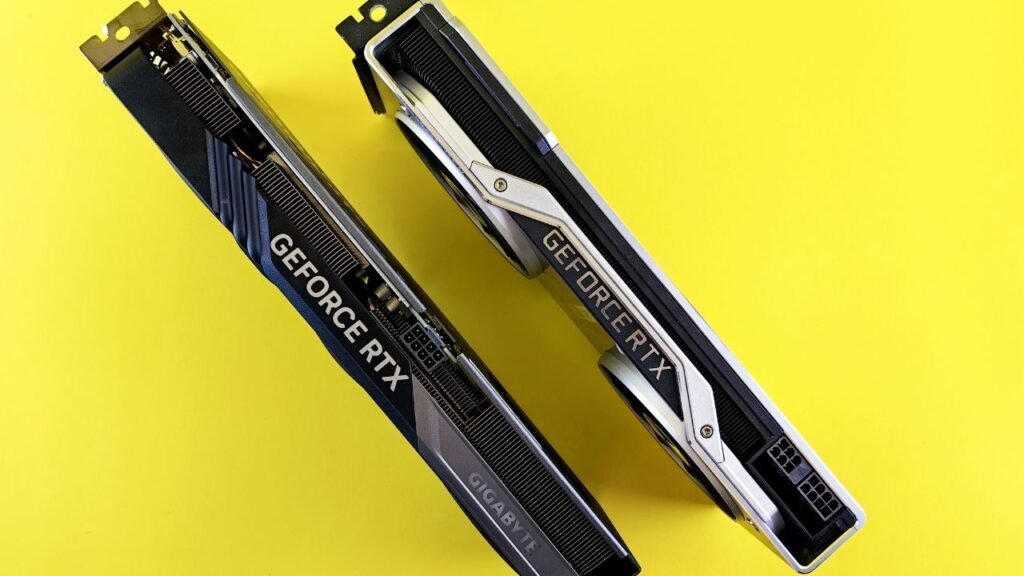
The 2026 picture is different. In autumn 2024, ahead of the RTX 50 launch, a Digital Trends report citing Board Channels, shared by Gazlog, said the RTX 4090 had already seen its final shipments, with the 4080 Super and 4070 Ti Super also winding down, and that a new 4090 was hard to find under $2,200 at the time. The page shows no date, so I’m dating it from its own context. It’s also a leak-based report, not an official statement from Nvidia.
The MLQ roundup lists a past low of $729 for the RTX 5070 Ti against roughly $950 now (and $749 at launch), and says the earlier discounts, a Memorial Day promotion and a May lightning sale, were temporary offers rather than lasting prices.
My read: cards get cheap when sellers are stuck holding unsold stock, as in 2022. Discontinuation alone doesn’t do it, and plenty of things move prices, including demand, availability and what replaces the card. Right now I can’t find evidence of a glut.
So who actually benefits
My ledger, with the confidence level attached to each line.
Nvidia’s data center business is the clearest verified winner: $89.0 billion of the quarter’s revenue, up 117% from a year ago.
Memory makers look like likely beneficiaries. They report strong demand, and TrendForce reports price hikes of nearly 20%, though that report is unconfirmed. Board partners and shops are harder to call. They were in the room when prices rose, but the evidence is old or missing, and I can’t show they’re profiting.
AMD isn’t a clean “loser” story. Its Gaming segment revenue was $779 million, down 31% year over year, which AMD attributed to “lower semi-custom revenue,” meaning mostly console chips. That segment includes more than Radeon cards, so I can’t pin the drop on the GPU shortage. Lisa Su separately said that higher industry-wide component costs raised graphics card prices and weighed on demand.
And buyers pay. The table above shows the gap between MSRP and the lowest price cited, and that part I can verify.
The fair objection
The strongest counterargument is also the boring one: it’s a supply problem, not a plot. Nvidia says it ships all GeForce SKUs. The Tom’s Hardware August report frames the problem mainly as a memory shortage, with rising GDDR7 and wafer costs. Newegg blamed tariffs in 2025. All of that is real.
I buy most of it. I’m not claiming anyone is rigging anything.
Where I stay unconvinced is the allocation. If memory really is rationed by something like revenue per gigabyte, the card that earns about $88 a gigabyte would get priority over the one that earns about $27, and the 16GB gaming cards would feel the squeeze first. That’s a sensible business decision, and it needs no villain. It’s also a hypothesis I can’t prove with the public data.
What would change my mind
If 16GB cards drifted back toward MSRP while HBM stayed sold out, I’d say I was wrong about the allocation story. If Nvidia published gaming revenue again, I’d be able to say more, one way or the other.
For supply relief, SoftwareSeni says meaningful expansion of CoWoS packaging capacity takes 12 to 24 months and doesn’t expect near-term relief before 2027. That’s one outlet’s read, and packaging mainly affects AI accelerators, so its effect on gaming card prices is indirect. Treat it as a hint, not a promise.
How this was checked, and what’s still open
Every linked page was opened and compared against the claim attached to it. Price figures are early-August 2026 snapshots, last reviewed on October 13, 2026. I haven’t tested any of these cards, so this is analysis, not a review.
Some things I couldn’t confirm. There’s no reliable public figure for current retailer or partner margins. The reported 30 to 40% RTX 50 supply cut has never been confirmed by Nvidia. I couldn’t open Tom’s Hardware’s original Eddie Lin interview or Clarifai’s original 70% estimate, and I couldn’t confirm the exact method behind the revenue-per-gigabyte chart beyond the arithmetic.
Disclaimer: Prices and availability are based on the sources and dates cited and may change by retailer, region, and stock availability. Industry estimates and unconfirmed reports are identified as such. Analysis and opinions in this article represent interpretations of the available evidence and should not be treated as confirmed statements about company decisions or motives. Sources are provided for readers to verify the underlying information.
Sources: Tom’s Hardware, RTX 50 prices (Aug 7, 2026), MLQ GPU price roundup, Epoch AI, AI chip supply chain constraints, Notebookcheck on SK hynix, Micron Q4 FY2025 call transcript, TrendForce on HBM3E prices, SoftwareSeni on memory bottlenecks, HWBusters on data center memory demand, Wccftech on Eddie Lin, Tom’s Guide on revenue per gigabyte, Outlook Respawn on RTX 50 supply, Nvidia Q2 fiscal 2027 results, Nvidia Q1 FY2027 CFO commentary (SEC), TweakTown on Nvidia’s report, TechSpot on EVGA, PCGamesN on board partner margins, PCMag via Yahoo Tech on Newegg and tariffs, Tom’s Hardware on 2022 RTX 30 discounts, Digital Trends on RTX 40 final shipments, AMD Q2 2026 results (SEC filing), Tom’s Hardware on AMD’s results.