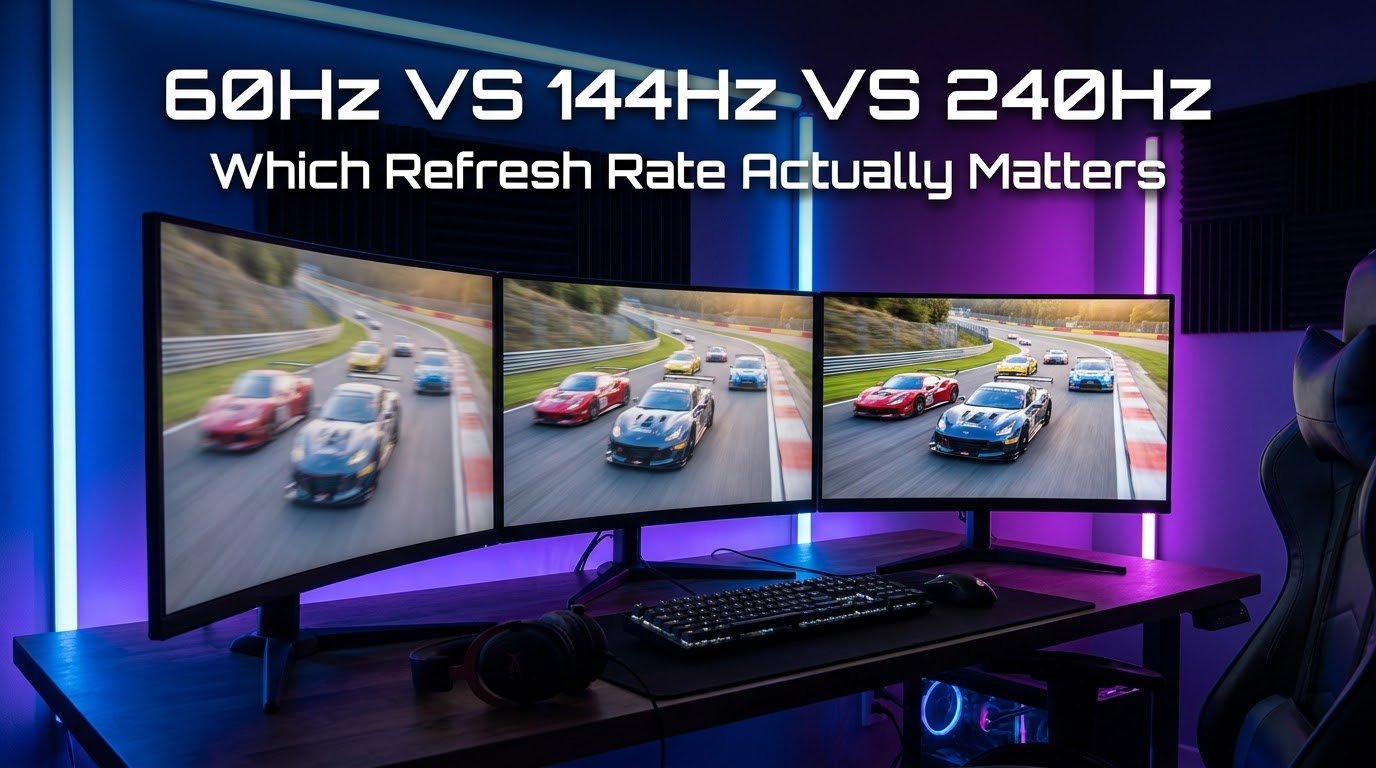
I used to think my aim was just bad. Genuinely bad. I’d get outgunned in CS:GO by players who seemed to react half a second faster than me, every single time, and I chalked it up to lack of skill.
Then I played on a friend’s setup with a 144Hz monitor and it felt like someone had turned on a cheat code. Movement was smoother, flicks felt more accurate, and enemies just looked easier to track. I wasn’t suddenly better at the game. My monitor had just been holding me back the entire time without me realizing it.
That one afternoon changed how I thought about PC gaming completely, and it’s why I want to break this down properly instead of just throwing numbers at you.
What Refresh Rate Actually Means (In Plain Terms)
Refresh rate is how many times your monitor updates the image on screen per second, measured in Hertz (Hz). A 60Hz monitor refreshes 60 times per second. A 144Hz monitor refreshes 144 times per second. A 240Hz monitor refreshes 240 times per second.
More refreshes per second means smoother motion, less blur during fast movement, and in competitive games, a genuine edge in reaction time.
I want to be clear about something though: refresh rate isn’t magic. It won’t turn a beginner into a pro overnight. What it does is remove a barrier that was quietly working against you the whole time, similar to playing with a laggy mouse versus a responsive one.
My Actual Experience With All Three
60Hz: Where I Started
I gamed on a 60Hz monitor for years without knowing anything different existed. Honestly, games looked fine to me. Story-based games, slower-paced titles, even some shooters felt perfectly playable.
The problems only became obvious in hindsight. Fast camera movements looked slightly blurry. Fast-paced competitive games felt “sticky” in a way I couldn’t quite explain at the time. I just assumed that was normal because I had nothing to compare it to.
144Hz: The Upgrade That Actually Surprised Me
When I finally bought my own 144Hz monitor after that friend’s setup convinced me, the difference was way more noticeable than I expected. I genuinely thought it might be a placebo effect at first.
It wasn’t. Mouse movement felt tighter. Scrolling through websites even felt smoother, which I didn’t expect outside of gaming. In games like Valorant and Apex Legends, tracking moving enemies became noticeably easier because there was less motion blur between frames.
My aim didn’t magically become pro-level, but my consistency improved. I stopped losing gunfights simply because I couldn’t track movement cleanly.
240Hz: Where Diminishing Returns Kick In
I tested a 240Hz monitor at a local gaming cafe out of curiosity, and here’s my honest take: the jump from 60Hz to 144Hz felt bigger than the jump from 144Hz to 240Hz.
That’s not to say 240Hz isn’t smoother, it genuinely is, but the difference becomes much harder to notice unless you’re playing at a competitive or professional level, or you’re specifically trained to notice frame-by-frame differences.
For casual and even semi-competitive players, I’d argue 144Hz hits the sweet spot of noticeable improvement without paying a premium for marginal extra smoothness.
Step-by-Step: How To Actually Decide What You Need
Step 1: Check What Your GPU Can Actually Push
This is the mistake I made initially. I almost bought a 240Hz monitor before realizing my GPU at the time couldn’t even consistently hit 100 frames per second in the games I played.
A high refresh rate monitor is wasted if your graphics card can’t produce enough frames to fill it. Check your average FPS in your most-played games using an overlay tool like MSI Afterburner or the built-in FPS counter in Steam.
If you’re consistently capping around 75-90 FPS, a 144Hz monitor makes sense. If you’re regularly hitting 200+ FPS in competitive titles, a 240Hz monitor becomes worth considering.

Step 2: Think About What Games You Actually Play
Slower-paced games like story-driven RPGs, strategy games, or simulation titles benefit far less from high refresh rates. I still play games like Civilization or Stardew Valley without noticing much difference between 60Hz and 144Hz.
Fast-paced competitive shooters and racing games are where refresh rate genuinely matters. If your main games are Valorant, CS2, Apex Legends, or Rocket League, upgrading pays off much more noticeably.
Step 3: Match Your Monitor’s Response Time Too
This part gets overlooked constantly. Refresh rate isn’t the only spec that matters. Response time, measured in milliseconds (ms), affects how quickly individual pixels change color.
I made the mistake of buying a cheap 144Hz monitor with a slow response time once, and it actually introduced ghosting, a trailing blur effect behind fast-moving objects. Look for a response time of 1ms or as close to it as possible if you’re buying specifically for competitive gaming.
Step 4: Enable The Right Settings After Buying
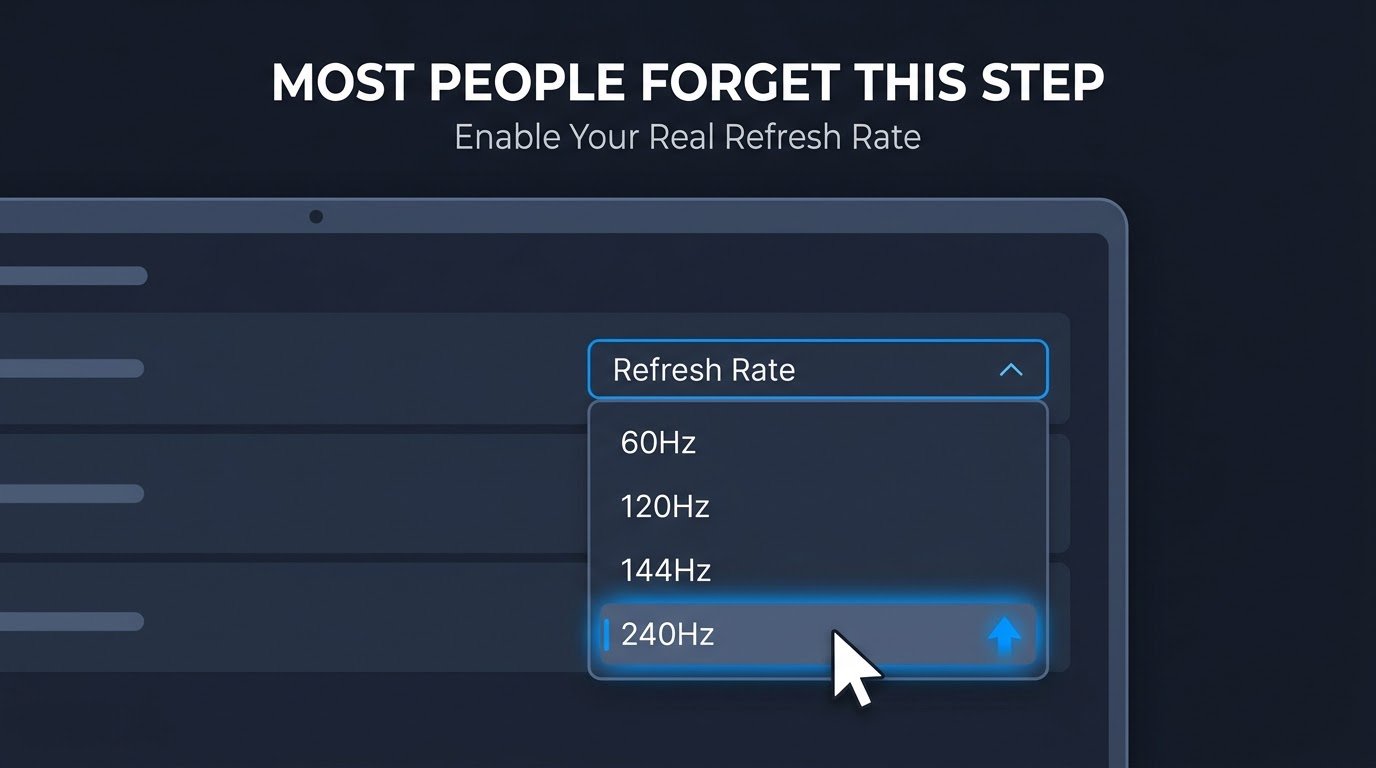
Buying a high refresh rate monitor isn’t the end of the process. I plugged mine in initially and didn’t realize Windows was still capped at 60Hz by default.
Go to Settings, then System, then Display, then Advanced Display Settings, and manually select your monitor’s maximum refresh rate. I genuinely used a 144Hz monitor for two days at 60Hz without realizing my mistake, and I felt silly once I figured it out.
Step 5: Enable G-Sync or FreeSync If Your Setup Supports It
If you’re using an Nvidia GPU with a G-Sync compatible monitor, or an AMD GPU with FreeSync, enabling this feature syncs your frame rate with your monitor’s refresh rate and reduces screen tearing significantly.
I noticed a real difference turning this on, especially during fast camera pans where tearing used to be most noticeable.
Real Examples From My Own Setup
On my current 144Hz monitor paired with a mid-range GPU, I average around 130-160 FPS in Valorant and around 100-120 FPS in more demanding titles like GTA V. That’s a comfortable match for a 144Hz panel without needing to upgrade further.
A friend of mine runs a 240Hz monitor with a high-end GPU specifically for competitive CS2 play, consistently hitting 250+ FPS. For his use case, that upgrade genuinely makes sense. For casual players, that same setup would likely feel like overkill.
If you’re just getting into PC gaming and trying to figure out what actually matters when building or buying your first setup, I covered the broader basics in The Ultimate Beginner’s Guide to PC Gaming, which pairs well with this if you’re still deciding on your overall setup, not just the monitor.
Common Mistakes People Make
Buying a high refresh rate monitor without checking their GPU’s capability first. I almost made this mistake myself. A 240Hz monitor paired with a weak GPU is genuinely wasted money.
Forgetting to actually enable the higher refresh rate in Windows settings. This one is embarrassingly common. I did it myself and felt ridiculous once I realized.
Ignoring response time completely. A high refresh rate with a slow response time still results in visible ghosting and blur, which defeats a lot of the purpose of upgrading in the first place.
Assuming every game benefits equally. Story-driven or slower-paced games won’t feel dramatically different at higher refresh rates the way competitive shooters do.
Overspending on 240Hz when 144Hz would genuinely be enough. Unless you’re playing at a competitive level or specifically chasing every possible frame advantage, the price jump often isn’t worth it for casual players.
Final Thoughts
Refresh rate genuinely changed how I experience gaming, but it’s not some universal fix that instantly improves your skill. It removes a technical limitation that a lot of players don’t even realize is holding them back, myself included for years.
If you’re deciding between 60Hz, 144Hz, and 240Hz, be honest about what games you actually play and what your GPU can realistically support. For most people, 144Hz hits that sweet spot of noticeable smoothness without unnecessary spending.
Try to test one in person if you can, at a friend’s setup, a gaming cafe, or even a tech store display. Numbers on a spec sheet only tell part of the story. Actually seeing the difference is what convinced me, and it’ll probably do the same for you.
For a deeper technical breakdown of refresh rate and how it affects motion clarity, RTINGS’ monitor refresh rate explainer is a solid resource if you want to go further into the display science side of things.