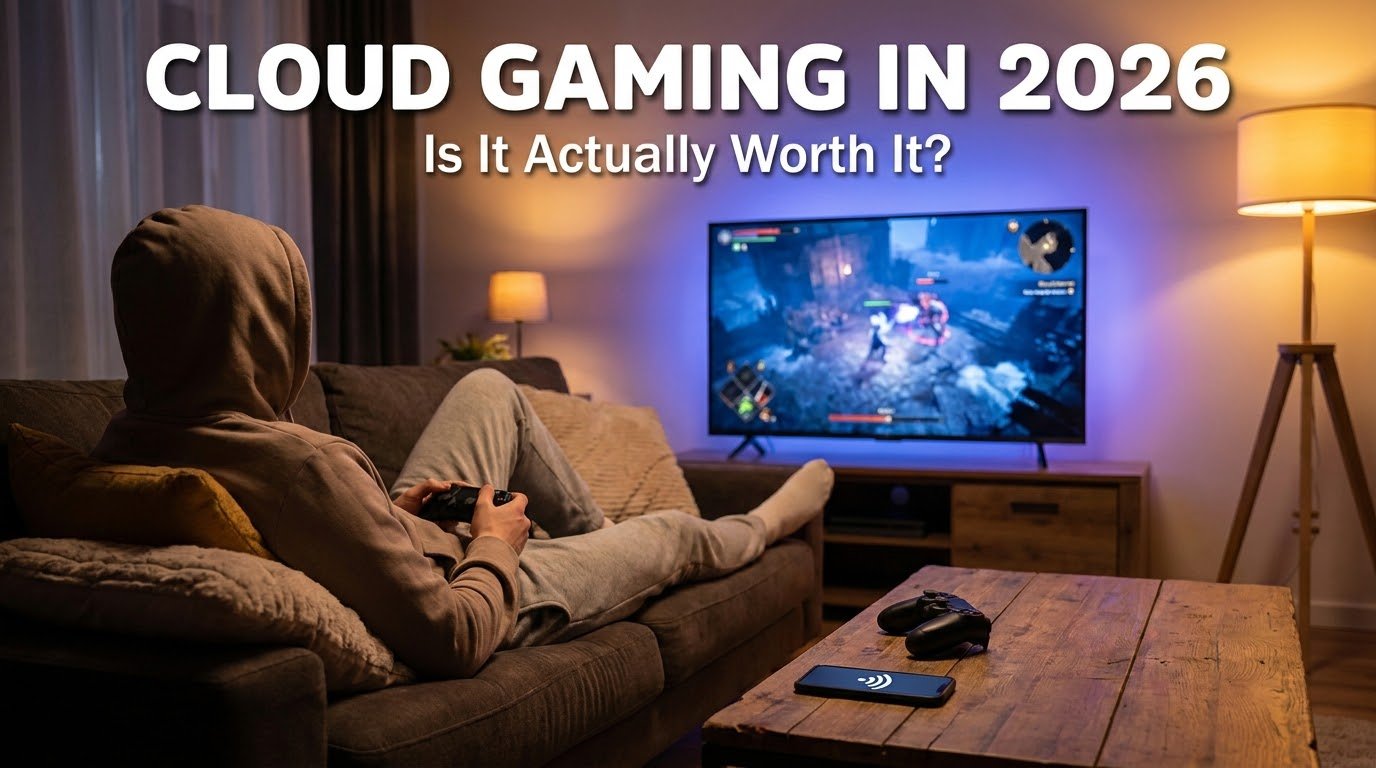
I almost didn’t write this post because I was tired of being wrong about cloud gaming.
Back in 2023 I told a friend that cloud gaming was “basically a gimmick until fiber internet is everywhere.” Then my gaming PC’s GPU fan started grinding like a coffee bean roaster last winter, I didn’t have $600 lying around for a new card, and I ended up streaming games from my laptop, my TV, and even my phone for about four months straight while I saved up.
That stretch taught me more about cloud gaming than any spec sheet ever could. So instead of another “here are the features” roundup, this is what actually happened when I leaned on Xbox Cloud Gaming, GeForce Now, and Amazon Luna as my main way to play including the stuff that went wrong.
Quick context: why this comparison looks different in 2026
If you read an older comparison article, ignore half of it. The cloud gaming landscape shifted a lot this year:
- Amazon Luna quietly stripped out its game store, killed “Bring Your Own Library,” and cut ties with EA, Ubisoft, and GOG storefronts between April and June 2026. It’s now basically a Prime-bundled perk called Luna Premium (around $10/month) with a curated catalog of roughly 150 games, rather than a place to build your own library.
- GeForce Now introduced a 100-hour monthly playtime cap on paid tiers, with top-up blocks if you go over. That’s a real change if you’re a heavy player.
- Xbox Game Pass Ultimate (which bundles Xbox Cloud Gaming) had a rocky year price-wise, it jumped to $29.99 a month in late 2025, then Microsoft walked it back down to $22.99 in April 2026 after backlash.
None of that is dealbreaker information on its own, but it changes the math on which service actually makes sense for you right now. Let’s get into it properly.

What “worth it” actually means (my definition, not a marketing one)
Before the breakdown, here’s the bar I use. Cloud gaming is worth it if:
- You can play the games you actually want, not just a rotating “sample platter.”
- The stream feels responsive enough that you forget it’s streaming, most of the time.
- The monthly cost is lower than what you’d spend maintaining hardware for the same games.
If a service fails two of those three, I don’t think it’s worth it for that person, even if it’s technically impressive.
Xbox Cloud Gaming — the one that felt the most “normal”
I used this mostly on an old Samsung smart TV (via the Xbox app) and on my phone with a clip-on controller during lunch breaks.
What surprised me: it just worked more often than I expected. No installs, no updates sitting at 40% while I stare at a progress bar. I’d open Halo Infinite or Forza Horizon 5 on my phone in a parking lot and be in a match inside 90 seconds.
What actually bugged me: input lag was noticeable in fast, twitchy games. I play a lot of racing and shooter titles, and cornering in Forza sometimes felt like there was a tiny rubber band between my thumb and the car. Turn-based or slower games (persona-style RPGs, strategy games) felt completely fine — you genuinely can’t tell the difference from local play.
Mistake I made: I tried playing on public café Wi-Fi once, assuming “internet is internet.” It was rough pixelation during any fast motion, and one match where the game just froze for four seconds mid-fight. Lesson learned: cloud gaming is only as good as your weakest network hop, not your average speed.
Real cost check: Xbox Cloud Gaming comes bundled inside Game Pass Ultimate, which sits at $22.99/month as of mid-2026 after Microsoft’s price cut in April. You’re not paying for cloud gaming specifically, you’re paying for the whole Game Pass library plus the ability to stream it, which is honestly the better deal if you also play console or PC.
GeForce Now — the most “premium feel,” but watch the hour cap
This is the one I used the most, mostly because I already owned a bunch of games on Steam and Epic, and GeForce Now streams games from your existing library instead of forcing you to rebuy or resubscribe to access them.
What surprised me: the visual quality on the Ultimate tier (RTX 5080-class servers as of this year) genuinely looked better than my old GPU could push. Cyberpunk 2077 with ray tracing maxed out, streamed to a $250 Chromebook I keep for travel that felt like magic the first time.
What actually bugged me: the new 100-hour monthly cap. I didn’t hit it during a normal month, but during the week my GPU was dead and cloud gaming was my only option, I blew past it fast, and had to pay $5.99 for extra 15-hour blocks on Ultimate. If you’re using this as a full-time replacement for owning a PC, budget for that.
Mistake I made: I subscribed to the monthly plan out of laziness instead of checking for a yearly deal. NVIDIA has been running deep annual discounts (Ultimate dropped to around $130/year during a mid-2026 promo, versus roughly $240/year at the standard monthly rate). If you’re committing for more than 3-4 months, always check the annual pricing page first.
Real cost check (2026 numbers): Free tier (1-hour sessions, queues), Performance around $9.99/month, Ultimate around $19.99/month or discounted annual passes when they run promos.
Amazon Luna — good for casual play, not for building a library anymore
I want to be fair to Luna here because I think a lot of people are judging it based on what it used to be.
What surprised me: for quick, low-commitment sessions think Jackbox with friends, or a GameNight title on the TV. Luna is genuinely pleasant. Zero setup, works inside the Prime ecosystem I already pay for, and my nephew was playing within a minute on a Fire TV Stick.
What actually bugged me: this year Amazon shut down Luna’s game store, killed the “Bring Your Own Library” feature that let you stream games you owned on EA, Ubisoft, and GOG, and stopped selling Ubisoft+ and Jackbox subscriptions through the platform. If you bought games directly through Luna, they stopped streaming after June 10, 2026 no refunds. Amazon gave users a short window to download local save files, but there was no guarantee those saves would even work on other platforms.
Mistake I nearly made: I’d bought a couple of games directly through Luna’s old storefront and almost didn’t notice the shutdown emails until my library actually disappeared. If you were a Luna store customer, go grab your save data now the download window closes and Amazon has been upfront that it can’t promise those saves will transfer cleanly.
Real cost check: Luna is now essentially Luna Premium at roughly $10/month, offering a curated catalog (around 150 titles as of mid-2026, leaning older/catalog games with a few standouts like Hogwarts Legacy). It’s a Prime perk now, not a PC-replacement platform.
Step-by-step: how I’d actually test these before paying for a year of anything
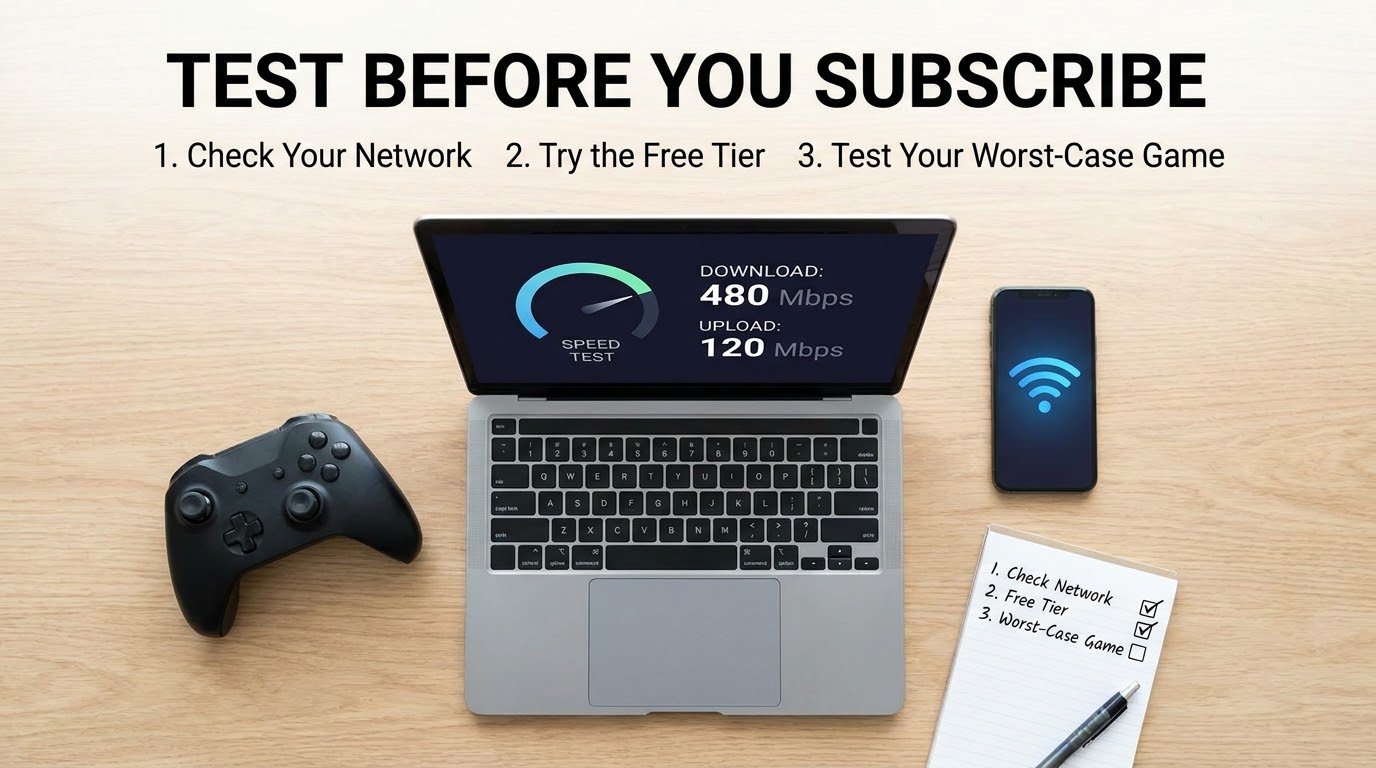
- Test your network honestly. Run a wired speed test and a Wi-Fi speed test from the room you’ll actually play in. Cloud gaming wants consistency more than raw speed — a stable 25 Mbps beats a spiky 100 Mbps.
- Start with the free tiers. Xbox Cloud Gaming is included if you already have Game Pass Ultimate; GeForce Now has a genuinely usable free tier (just expect queues and 1-hour sessions).
- Play your worst-case game, not your best-case game. Test a fast shooter or racing game, not a turn-based RPG. If a twitchy game feels fine, everything else will too.
- Check what you actually own already. If your library is mostly Steam/Epic PC games, GeForce Now is the only one of these three that streams games you already bought. Xbox Cloud and Luna are catalog-based.
- Do the annual math before committing monthly. Every one of these services has run a discounted annual promo at some point this year check before you pay full monthly price for more than a couple months.
Common mistakes people make with cloud gaming
- Assuming “fast internet” means “good cloud gaming.” Latency and packet stability matter more than download speed. A wired ethernet connection beats Wi-Fi almost every time.
- Buying games directly through a cloud storefront without checking the platform’s track record. Luna’s 2026 shutdown of its own game store is exactly the scenario to keep in mind cloud-exclusive purchases can vanish if the company changes strategy.
- Ignoring hour caps. If you’re a heavy daily player, GeForce Now’s 100-hour cap can sneak up on you and add real cost.
- Judging the whole category off one bad session. I almost gave up on Xbox Cloud Gaming after that café Wi-Fi disaster. Testing on a stable connection changed my whole opinion.
So, is it actually worth it in 2026?
For me, yes but as a supplement, not a full replacement for owning hardware. During those four months without a working GPU, cloud gaming genuinely kept me playing without missing a beat on slower or story-driven games, and it was “good enough” even on faster ones.
If I had to rank them for most people right now: GeForce Now for PC gamers who already own their library and don’t mind managing playtime, Xbox Cloud Gaming for anyone already paying for Game Pass Ultimate since it’s essentially a free bonus, and Luna for casual, low-stakes group gaming through Prime rather than as your main platform.
None of them fully replace a good gaming rig yet, especially for competitive or twitch-reflex games. But for the average person who plays a few hours a week and doesn’t want to drop hundreds of dollars on a GPU that might be outdated in three years yeah, it’s worth it. Just go in knowing which service matches how you actually play, not how the ads say you’ll play.
If you’re curious how far mobile game streaming has come more broadly, this breakdown of playing GTA 5 on mobile is a good look at another angle of the same trend running heavier games on devices that technically shouldn’t be able to handle them.
For the underlying technical side of how video compression and streaming latency actually work, Google’s overview of how video works on the web is a solid, non-marketing explainer if you want to go deeper than “trust me, it just streams.”