I remember the exact night this happened to me. I’d just gotten home from a long shift, ordered food, and was genuinely excited to finally sit down and play a game I’d been waiting to install all week. I double-clicked the icon, the little loading cursor spun for a second… and then nothing. No error, no window, no crash report. Just silence, like the game had opened its eyes, looked around, and decided it wasn’t in the mood.
If you’ve ever sat there clicking the same icon five times in a row like that’s somehow going to change the outcome, you already know exactly the feeling I’m talking about.
The annoying part about games that won’t launch on Windows is that there’s rarely one single cause. Sometimes it’s something dumb and simple, like a background update stuck at 99%. Other times it’s a driver conflict, a corrupted file, or Windows quietly blocking something in the name of “security.” I’ve dealt with all of these at different points, and over time I built a pretty reliable checklist for figuring out what’s actually going on instead of just guessing and reinstalling everything.
So let’s go through it properly, the way I actually troubleshoot it myself.
First, Don’t Panic and Reinstall Immediately
This was my first mistake years ago. A game wouldn’t open, so my instant reaction was to uninstall and redownload the whole thing. Two hours later, same problem. Turns out the issue had nothing to do with the game files at all it was a background process from a previous session still running and blocking the new one from starting.
Before you nuke anything, open Task Manager (Ctrl + Shift + Esc) and check if the game is already listed as running in the background. If it is, end the task, wait a few seconds, and try launching again. This alone fixes launch issues more often than people expect.
Step 1: Restart Your PC (Yes, Really)
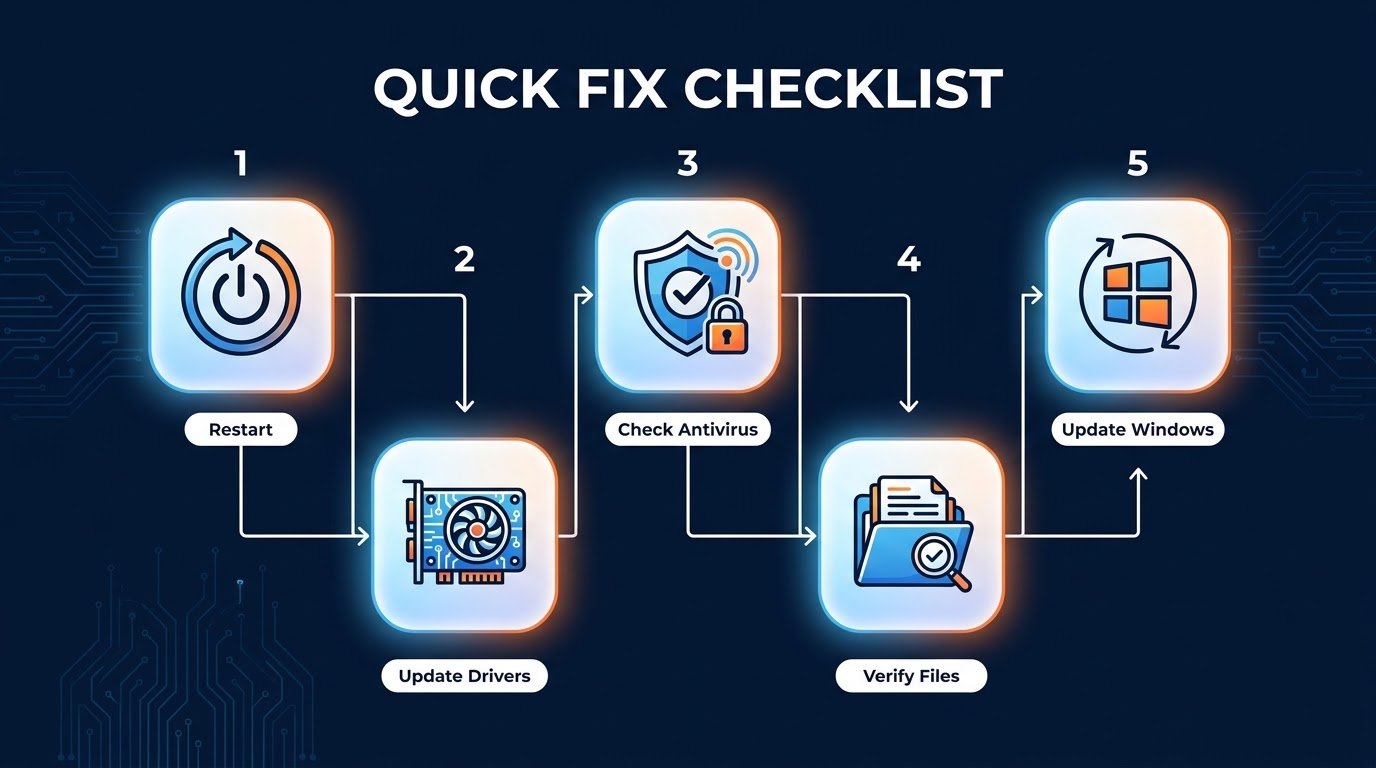
I know it sounds like the most basic tech support cliché ever, but hear me out. A lot of “won’t launch” issues happen because something else like a driver, an overlay, or a background service is stuck in a weird state. A full restart clears temporary memory and forces services to reload properly.
I’ve had games that flat-out refused to open, and after a restart, they opened on the first try like nothing ever happened. It’s not glamorous advice, but it works often enough that I always do it first.
Step 2: Update Your Graphics Drivers
This one caught me off guard the first time. I assumed my drivers were fine because Windows Update never flagged anything. But Windows Update and actual GPU manufacturer updates are two very different things.
If you have an NVIDIA card, go grab the NVIDIA App (it replaced GeForce Experience) and update from there. AMD users should check AMD Software: Adrenalin Edition. Intel integrated graphics users can check Intel’s driver assistant tool.
Outdated or corrupted graphics drivers are one of the most common reasons games silently fail to launch, especially newer titles that rely on the latest DirectX or Vulkan features.
Step 3: Run the Game as Administrator
Some games need elevated permissions to access certain system files, especially anti-cheat protected ones. Right-click the game’s shortcut or executable, choose “Run as administrator,” and see if that changes anything.
If it does launch that way, you can save yourself the hassle each time by right-clicking the shortcut, going to Properties, then Compatibility, and checking “Run this program as an administrator” permanently.
Step 4: Check Your Antivirus and Windows Defender
This one is sneaky because there’s usually no obvious warning. Sometimes Windows Defender or a third-party antivirus quietly quarantines a game file it doesn’t recognize, especially right after an update. The game just… won’t open, with zero explanation.
Go into Windows Security, check “Protection history” under Virus & threat protection, and see if anything related to your game got flagged recently. If it did, you can restore the file and add an exclusion for the game’s install folder so it doesn’t happen again.
I had this exact situation with a smaller indie game that used an unusual launcher. Defender flagged it as suspicious purely because it wasn’t a widely recognized program yet. Once I added an exclusion, it launched instantly.
Step 5: Verify Game File Integrity
If you’re using Steam, this is genuinely one of the most underrated fixes. Right-click the game in your library, go to Properties, then Local Files, and click “Verify integrity of game files.” Steam will scan everything and redownload anything that’s missing or corrupted.
Epic Games Launcher has a similar option under the three-dot menu on a game’s page called “Verify.”
I can’t count how many times a launch failure turned out to be one single corrupted file that verification quietly fixed in under two minutes, saving me from a full reinstall.
Step 6: Update Windows Itself
I used to skip Windows updates constantly because they always seemed to interrupt me at the worst times. But a few major game engines actually depend on system-level components that get patched through Windows Update, including things like .NET Framework, Visual C++ Redistributables, and DirectX components.
Go to Settings > Windows Update and check for anything pending. It’s boring, but it closes a surprising number of compatibility gaps.
Step 7: Reinstall Visual C++ Redistributables and DirectX
This is one people rarely think about because it feels like something “the game should handle automatically.” Most games do install these during setup, but sometimes the installation gets interrupted or a version conflict happens.
You can manually download the latest Visual C++ Redistributable packages directly from Microsoft’s official site, and run the DirectX End-User Runtime installer as well. This fixed a launch issue for me with an older title that kept crashing before even reaching the main menu.
Step 8: Check Compatibility Mode for Older Games
If you’re trying to run something older on a newer version of Windows, sometimes it just doesn’t know how to behave properly. Right-click the executable, go to Properties, then Compatibility tab, and try running it in compatibility mode for an earlier Windows version like Windows 7 or Windows 8.
I had an old strategy game from years back that simply refused to launch on Windows 11 until I set compatibility mode to Windows 7. No other fix worked except that one setting.
Step 9: Check for Overlay Conflicts
Overlays like Discord, GeForce Experience, RGB software, or even Xbox Game Bar can occasionally interfere with a game’s launch process, especially if two overlays try to hook into the game at the same time.
Try disabling the Discord overlay temporarily (Settings > Overlay in Discord), and also turn off Xbox Game Bar under Settings > Gaming. It sounds unrelated, but overlay conflicts are more common than people realize, especially with newer game releases.
A Mistake I Made That Wasted an Entire Evening
I once spent almost three hours convinced my GPU was dying because a game kept crashing on launch. I updated drivers, reinstalled the game twice, even considered reinstalling Windows entirely out of frustration.
Turns out my storage drive was almost completely full. Windows needs breathing room to create temporary files, and many games fail silently when there isn’t enough free space, without ever telling you that’s the actual problem.
Now the very first thing I check, before anything else on this list, is how much free space is left on my drive. It sounds too simple to be the answer, but it has been more than once.
Common Mistakes People Make When Troubleshooting This
- Reinstalling immediately without checking background processes first.
- Ignoring GPU driver updates because Windows says everything is “up to date.”
- Not checking antivirus quarantine logs.
- Forgetting to verify game files before assuming something is broken.
- Not checking available storage space.
- Skipping Windows updates for months and wondering why newer games misbehave.
Final Thoughts
Games not launching is one of those problems that feels dramatic in the moment but is usually fixable with patience rather than panic. Most of the time it’s not your hardware failing it’s a small conflict somewhere between drivers, permissions, or background software.
Work through these steps one at a time rather than doing everything at once. That way, when something finally works, you’ll actually know what fixed it, which makes the next time this happens a whole lot faster to deal with.